Category: <span>Blog</span>

Most Ph.D. students enter a fog as they wrap up seminars or comps. Recently I spoke with such a student–I could feel his frustration. He had gone from a structured schedule to the life of an independent researcher. He had left behind mates in a cohort for the solitary desk of reading and writing. Let me pass along a few ideas I shared with him. May these kindle afresh the curious spirit within you as well.


WRITING AND RESEARCH

Hit ‘Refresh’ on Your Research Issue

I recall one of my Professors once telling students in a Ph.D. seminar that what first prompted us is likely the area of study we should continue in for the long haul. So it may be helpful to find the latest book or article on your issue and see if reading it will reignite the excitement that first drove you to that area of study.

Ask More or New Questions

I suggest writing your issue in the center of a large whiteboard and then begin to cover the whiteboard with questions, using lines to connect each question to the issue at the center of the board. Writing these questions in a visible frame will likely  prompt further questions. Perhaps reading a new book or article will stimulate this process of interrogation. Then take a step back and organize those questions under various headings. This process may give you some structure for progress, suggesting a need for more research and new annotated bibliographies of those resources. Run with this a bit. It may be worth the effort to submit a book review or a paper to be read at ETS or SBL. In short, force yourself to ask and answer.

Organize or Re-Organize Your Research

Take a look through your bibliographies and organize them both by genre (Commentaries, Dissertations, etc) and by major contribution to the question-headings noted above. Begin to develop a problem-to-Solution frame of thinking with these recourses. That is, ask yourself two questions: (1) in light of my research, regarding my particular issue, what problems remain or have not been addressed clearly in recent days, and (2) what solutions might I propose for those issues?

Ancient rhetoricians developed a system of prompters to help them have something to say about any given issue. They called this system the Topics. I suggest getting hold of Corbett and Connors Classical Rhetoric for the Modern Student (New York: Oxford, 1999) for the full perspective, but in short the  Topics include: Comparison (Similarity, Difference, Degree), Relationship (Cause and Effect, Antecedent and Consequence) and Circumstance (Past Fact and Future Fact). You will notice that various critical theories of Biblical studies find points of contact with these. And herein lies a point of departure: many dissertations are attempts to understand a text in view of competing spheres of Biblical criticism and the Topics can help organize your understanding of the issue under investigation, and your presentation of a solution/clarification. And this brings to mind Phillips and Pugh’s How to get a PhD (New York: McGraw-Hill, 2005). If you have not read their guide to organizing and writing your dissertation according to the type of dissertation you are writing, your goals, get hold of it ASAP.

Develop a General Thesis Statement

The next step is crucial step: organize your thesis statement. I suggest the following rubric: “_________ (author/idea/text) is best understood in reference to ___________ (idea/interpretive framework/historical event/critical theory, etc).” This is just a rubric, but you will want to work toward being able to state your thesis in some kind of a problem-to-solution format that is succinct and memorable for you and the reader.

Organize Research According to your Thesis

Now it is time to go back through your research and get it organized according to the thesis. Along the way a natural outline should begin to develop. This is long process and will require refinement of the thesis. The best dissertations are those marked by coherence, one idea seamlessly leading to the next, and all ideas organized around a lucid thesis statement.


TIMELINE AND MOTIVATION

Personal and Family Interests

Continue to take these into account and once you settle on a schedule, do all you can to stick to it. I would suggest devoting the first two hours of each day to research and writing. Keep it simple in your schedule, but do-able and direct.

Reading

If you are needing to get the reading habits going again, give yourself to research and some good books in general. Read Julius Caesar by Shakespeare or some Dickens. See how words are used. Ben Franklin comes to mind as well. And yess–he had a practice called imitation (also covered in Corbett and Conners noted supra) in which he would copy or re-write ideas he found in print. This is a great practice! I remember reading a few paragraphs of dissertations that so impacted me, were so clear, that I copied them by hand word for word. This would be a good practice to keep you thinking about how to best express your ideas. I know the heading here is “Reading,” but reading good books will likely lead to writing your ideas more clearly.

Get out of Your Chair

For the last several years I have used a standing desk (or placed boxes on a traditional desk and set my computer and books on them). At first I did this because a physician told me it would help my back. In recent years I have heard that the medical community has adopted the phrase “sitting is the new smoking” to encourage office workers of all types to complete their work from a standing position as often as possible. I am not aware of all of the medical benefits, but for me standing keeps me alert and forces me to keep working. Tiredness in my legs drives my mind and hands so that by the end of the day my whole body has been engaged in the research and writing process.


JUST DO IT

More could be said, but the burden you alone can bear. Some students need more organizational help, like the ideas noted here. Others need some camaraderie in the research process; if that is you, then get some fellow ABD’s together and schedule times to report and read your research. Speak with your advisor about scheduling regular meetings for reading chapters of the dissertation. Whatever it takes…just do it. On graduation day you will walk across the stage alone having accomplished a feat to be proud of the rest of your life.

Blog

I was reading today in Gen 46 and noticed in v. 3 God’s statement to Jacob that he should not be afraid to go to Egypt. Below I have attached a hits list from Accordance identifying where that form of the Hebrew verb (2nd sg imperfect) is used.

In the Pentateuch it is fascinating how often it occurs in the context of: (1) noting of God’s presence or statements of His appearance in a vision, (2) times of transition for the human character in view, a la Gen 46:3, and (3) after historical review of God’s work for His people in history. Conclusion? Nearly always it is stated as the resultative attitude/emotional state God would have His people to take up after they have done some thinking about Him and His covenant faithfulness to them. The other major use is a statement that the human(s) in view should fear God–this too is a resultative attitude/posture in light of His greatness over opponents or foreign gods.

Pent: תירא

Gen. 15:1   After these events, the word of the LORD camea to Abram in a vision:

  Do not be afraid, Abram.

I am your shield;

your reward will be very great.

Gen. 26:24 and the LORD appeared to him that night and said, “I am the God of your father Abraham.a Do not be afraid, for I am with you.b I will bless you and multiply your offspring because of My servant Abraham.”

Gen. 46:3   God said, “I am God, the God of your father. Do not be afraid to go down to Egypt, for I will make you into a great nation there.

Num. 14:9 Only don’t rebel against the LORD, and don’t be afraid of the people of the land, for we will devour them. Their protection has been removed from them, and the LORD is with us. Don’t be afraid of them!”

Num. 21:34 But the LORD said to Moses, “Do not fear him, for I have handed him over to you along with his whole army and his land. Do to him as you did to Sihon king of the Amorites, who lived in Heshbon.”

Deut. 1:21 See, the LORD your God has set the land before you. Go up and take possession of it as Yahweh, the God of your fathers, has told you. Do not be afraid or discouraged.

Deut. 3:2 But the LORD said to me, ‘Do not fear him, for I have handed him over to you along with his whole army and his land. Do to him as you did to Sihon king of the Amorites,a who lived in Heshbon.’

Deut. 6:2 Do this so that you may fear the LORD your God all the days of your life by keeping all His statutes and commands I am giving you, your son, and your grandson, and so that you may have a long life.

Deut. 6:13 Fear Yahweh your God, worship Him, and take your oaths in His name.

Deut. 7:18 do not be afraid of them. Be sure to remember what the LORD your God did to Pharaoh and all Egypt:

Deut. 10:20 You are to fear Yahweh your God and worship Him. Remain faithful to Him and take oaths in His name.

Deut. 20:1   “When you go out to war against your enemies and see horses, chariots, and an army larger than yours, do not be afraid of them, for the LORD your God, who brought you out of the land of Egypt, is with you.

Deut. 31:8 The LORD is the One who will go before you. He will be with you; He will not leave you or forsake you. Do not be afraid or discouraged.”

Blog

This morning I was reading the account of the LORD’s appearance to Abraham in Genesis 12 and was struck (again) by the passive nature of the event. I recalled how these appearances of divine persons, angelic messengers or divine glory iterate the Hebrew scriptures and wondered how ὤφθη was used in the NT. Did Jesus “appear” to His disciples or the crowds? How so? In what contexts? I was struck by how rarely Jesus is the subject of ὤφθη during His earthly ministry; in fact, never. The Emmaus disciples reported to the eleven that the risen Jesus had appeared to them (Luke 24:34). Preaching in Pisidian Antioch, Paul announced likewise that the the risen Jesus had appeared to those who had known Him before the crucifixion (Acts 13:31). And Paul used ὤφθη in a formulaic, hymnic fashion in 1 Corinthians 15:5-8, likely a point of fulfillment within the storyline. So Anthony Thiselton: “Christ’s risen presence serves as God’s eschatological self-manifestation” (Thiselton, The First Epistle to the Corinthians [NIGTC, Grand Rapids: Eerdmans, 2000], 1199). [References below are from Bibleworks Greek Text.]

The 28 Greek OT Cannonical Occurrences of ὤφθη (3rd/sg/aor/pass/ind/ὁράω, “to see”) (references to the divine personal, angelic or glorious appearences in bold font)

BGT Gen. 1:9 καὶ εἶπεν ὁ θεός συναχθήτω τὸ ὕδωρ τὸ ὑποκάτω τοῦ οὐρανοῦ εἰς συναγωγὴν μίαν καὶ ὀφθήτω ἡ ξηρά καὶ ἐγένετο οὕτως καὶ συνήχθη τὸ ὕδωρ τὸ ὑποκάτω τοῦ οὐρανοῦ εἰς τὰς συναγωγὰς αὐτῶν καὶ ὤφθη ἡ ξηρά [Then God said, “Let the water under the sky be gathered into one place, and let the dry land appear.” And it was so. (Gen. 1:9 CSB)]

BGT Gen. 12:7 καὶ ὤφθη κύριος τῷ Αβραμ καὶ εἶπεν αὐτῷ τῷ σπέρματί σου δώσω τὴν γῆν ταύτην καὶ ᾠκοδόμησεν ἐκεῖ Αβραμ θυσιαστήριον κυρίῳ τῷ ὀφθέντι αὐτῷ [Genesis 12:7 Then the LORD appeared to Abram and said, “I will give this land to your offspring.” So he built an altar there to the LORD who had appeared to him. (Gen. 12:7 CSB)]

BGT Gen. 17:1 ἐγένετο δὲ Αβραμ ἐτῶν ἐνενήκοντα ἐννέα καὶ ὤφθη κύριος τῷ Αβραμ καὶ εἶπεν αὐτῷ ἐγώ εἰμι ὁ θεός σου εὐαρέστει ἐναντίον ἐμοῦ καὶ γίνου ἄμεμπτος [When Abram was 99 years old, the LORD appeared to him, saying, “I am God Almighty. Live in My presence and be blameless. (Gen. 17:1 CSB)]

BGT Gen. 18:1 ὤφθη δὲ αὐτῷ ὁ θεὸς πρὸς τῇ δρυὶ τῇ Μαμβρη καθημένου αὐτοῦ ἐπὶ τῆς θύρας τῆς σκηνῆς αὐτοῦ μεσημβρίας [Then the LORD appeared to Abraham at the oaks of Mamre while he was sitting in the entrance of his tent during the heat of the day. (Gen. 18:1 CSB)]

BGT Gen. 22:14 καὶ ἐκάλεσεν Αβρααμ τὸ ὄνομα τοῦ τόπου ἐκείνου κύριος εἶδεν ἵνα εἴπωσιν σήμερον ἐν τῷ ὄρει κύριος ὤφθη [And Abraham named that place The LORD Will Provide, so today it is said: “It will be provided on the LORD’s mountain.” (Gen. 22:14 CSB)]

BGT Gen. 26:2 ὤφθη δὲ αὐτῷ κύριος καὶ εἶπεν μὴ καταβῇς εἰς Αἴγυπτον κατοίκησον δὲ ἐν τῇ γῇ ᾗ ἄν σοι εἴπω [The LORD appeared to him and said, “Do not go down to Egypt. Live in the land that I tell you about (Gen. 26:2 CSB)]

BGT Gen. 26:24 καὶ ὤφθη αὐτῷ κύριος ἐν τῇ νυκτὶ ἐκείνῃ καὶ εἶπεν ἐγώ εἰμι ὁ θεὸς Αβρααμ τοῦ πατρός σου μὴ φοβοῦ μετὰ σοῦ γάρ εἰμι καὶ ηὐλόγηκά σε καὶ πληθυνῶ τὸ σπέρμα σου διὰ Αβρααμ τὸν πατέρα σου [and the LORD appeared to him that night and said, “I am the God of your father Abraham. Do not be afraid, for I am with you. I will bless you and multiply your offspring because of My servant Abraham.” (Gen. 26:24 CSB)]

BGT Gen. 35:9 ὤφθη δὲ ὁ θεὸς Ιακωβ ἔτι ἐν Λουζα ὅτε παρεγένετο ἐκ Μεσοποταμίας τῆς Συρίας καὶ ηὐλόγησεν αὐτὸν ὁ θεός [God appeared to Jacob again after he returned from Paddan-aram, and He blessed him. (Gen. 35:9 CSB)]

BGT Gen. 48:3 καὶ εἶπεν Ιακωβ τῷ Ιωσηφ ὁ θεός μου ὤφθη μοι ἐν Λουζα ἐν γῇ Χανααν καὶ εὐλόγησέν με [Jacob said to Joseph, ” God Almighty appeared to me at Luz in the land of Canaan and blessed me. (Gen. 48:3 CSB)]

BGT Exod. 3:2 ὤφθη δὲ αὐτῷ ἄγγελος κυρίου ἐν φλογὶ πυρὸς ἐκ τοῦ βάτου καὶ ὁρᾷ ὅτι ὁ βάτος καίεται πυρί ὁ δὲ βάτος οὐ κατεκαίετο [Then the Angel of the LORD appeared to him in a flame of fire within a bush. As Moses looked, he saw that the bush was on fire but was not consumed. (Exod. 3:2 CSB)]

BGT Exod. 16:10 ἡνίκα δὲ ἐλάλει Ααρων πάσῃ συναγωγῇ υἱῶν Ισραηλ καὶ ἐπεστράφησαν εἰς τὴν ἔρημον καὶ ἡ δόξα κυρίου ὤφθη ἐν νεφέλῃ [As Aaron was speaking to the entire Israelite community, they turned toward the wilderness, and there in a cloud the LORD’s glory appeared. (Exod. 16:10 CSB)]

BGT Lev. 9:23 καὶ εἰσῆλθεν Μωυσῆς καὶ Ααρων εἰς τὴν σκηνὴν τοῦ μαρτυρίου καὶ ἐξελθόντες εὐλόγησαν πάντα τὸν λαόν καὶ ὤφθη ἡ δόξα κυρίου παντὶ τῷ λαῷ [Moses and Aaron then entered the tent of meeting. When they came out, they blessed the people, and the glory of the LORD appeared to all the people. (Lev. 9:23 CSB)]

BGT Num. 14:10 καὶ εἶπεν πᾶσα ἡ συναγωγὴ καταλιθοβολῆσαι αὐτοὺς ἐν λίθοις καὶ ἡ δόξα κυρίου ὤφθη ἐν νεφέλῃ ἐπὶ τῆς σκηνῆς τοῦ μαρτυρίου ἐν πᾶσι τοῖς υἱοῖς Ισραηλ [While the whole community threatened to stone them, the glory of the LORD appeared to all the Israelites at the tent of meeting. (Num. 14:10 CSB)]

BGT Num. 16:19 καὶ ἐπισυνέστησεν ἐπ᾽ αὐτοὺς Κορε τὴν πᾶσαν αὐτοῦ συναγωγὴν παρὰ τὴν θύραν τῆς σκηνῆς τοῦ μαρτυρίου καὶ ὤφθη ἡ δόξα κυρίου πάσῃ τῇ συναγωγῇ [After Korah assembled the whole community against them at the entrance to the tent of meeting, the glory of the LORD appeared to the whole community. (Num. 16:19 CSB)]

BGT Num. 17:7 καὶ ἐγένετο ἐν τῷ ἐπισυστρέφεσθαι τὴν συναγωγὴν ἐπὶ Μωυσῆν καὶ Ααρων καὶ ὥρμησαν ἐπὶ τὴν σκηνὴν τοῦ μαρτυρίου καὶ τήνδε ἐκάλυψεν αὐτὴν ἡ νεφέλη καὶ ὤφθη ἡ δόξα κυρίου [When the community assembled against them, Moses and Aaron turned toward the tent of meeting, and suddenly the cloud covered it, and the LORD’s glory appeared. (Num. 16:42 CSB)]

BGT Num. 20:6 καὶ ἦλθεν Μωυσῆς καὶ Ααρων ἀπὸ προσώπου τῆς συναγωγῆς ἐπὶ τὴν θύραν τῆς σκηνῆς τοῦ μαρτυρίου καὶ ἔπεσαν ἐπὶ πρόσωπον καὶ ὤφθη ἡ δόξα κυρίου πρὸς αὐτούς [Then Moses and Aaron went from the presence of the assembly to the doorway of the tent of meeting. They fell down with their faces to the ground, and the glory of the LORD appeared to them. (Num. 20:6 CSB)]

BGT Jdg. 6:12 καὶ ὤφθη αὐτῷ ὁ ἄγγελος κυρίου καὶ εἶπεν πρὸς αὐτόν κύριος μετὰ σοῦ ἰσχυρὸς τῶν δυνάμεων [Then the Angel of the LORD appeared to him and said: “The LORD is with you, mighty warrior.” (Jdg. 6:12 CSB)]

BGT Jdg. 13:3 καὶ ὤφθη ἄγγελος κυρίου πρὸς τὴν γυναῖκα καὶ εἶπεν πρὸς αὐτήν ἰδοὺ σὺ στεῖρα καὶ οὐ τέτοκας καὶ συλλήμψῃ υἱόν [The Angel of the LORD appeared to the woman and said to her, “It is true that you are unable to conceive and have no children, but you will conceive and give birth to a son. (Jdg. 13:3 CSB)]

BGT 2 Sam. 22:11 καὶ ἐπεκάθισεν ἐπὶ Χερουβιν καὶ ἐπετάσθη καὶ ὤφθη ἐπὶ πτερύγων ἀνέμου [He rode on a cherub and flew, soaring on the wings of the wind. (2 Sam. 22:11 CSB)]

BGT 1 Ki. 3:5 καὶ ὤφθη κύριος τῷ Σαλωμων ἐν ὕπνῳ τὴν νύκτα καὶ εἶπεν κύριος πρὸς Σαλωμων αἴτησαί τι αἴτημα σαυτῷ [At Gibeon the LORD appeared to Solomon in a dream at night. God said, “Ask. What should I give you?” (1 Ki. 3:5 CSB)]

BGT 1 Ki. 9:2 καὶ ὤφθη κύριος τῷ Σαλωμων δεύτερον καθὼς ὤφθη ἐν Γαβαων [the LORD appeared to Solomon a second time just as He had appeared to him at Gibeon. (1 Ki. 9:2 CSB)]

BGT 2 Chr. 1:7 ἐν τῇ νυκτὶ ἐκείνῃ ὤφθη ὁ θεὸς τῷ Σαλωμων καὶ εἶπεν αὐτῷ αἴτησαι τί σοι δῶ [That night God appeared to Solomon and said to him: “Ask. What should I give you?” (2 Chr. 1:7 CSB)]

BGT 2 Chr. 3:1 καὶ ἤρξατο Σαλωμων τοῦ οἰκοδομεῖν τὸν οἶκον κυρίου ἐν Ιερουσαλημ ἐν ὄρει τοῦ Αμορια οὗ ὤφθη κύριος τῷ Δαυιδ πατρὶ αὐτοῦ ἐν τῷ τόπῳ ᾧ ἡτοίμασεν Δαυιδ ἐν ἅλῳ Ορνα τοῦ Ιεβουσαίου [Then Solomon began to build the LORD’s temple in Jerusalem on Mount Moriah where the LORD had appeared to his father David, at the site David had prepared on the threshing floor of Ornan the Jebusite. (2 Chr. 3:1 CSB)]

BGT 2 Chr. 7:12 καὶ ὤφθη ὁ θεὸς τῷ Σαλωμων τὴν νύκτα καὶ εἶπεν αὐτῷ ἤκουσα τῆς προσευχῆς σου καὶ ἐξελεξάμην ἐν τῷ τόπῳ τούτῳ ἐμαυτῷ εἰς οἶκον θυσίας [Then the LORD appeared to Solomon at night and said to him: I have heard your prayer and have chosen this place for Myself as a temple of sacrifice. (2 Chr. 7:12 CSB)]

BGT Song of Sol 2:12 τὰ ἄνθη ὤφθη ἐν τῇ γῇ καιρὸς τῆς τομῆς ἔφθακεν φωνὴ τοῦ τρυγόνος ἠκούσθη ἐν τῇ γῇ ἡμῶν [The blossoms appear in the countryside. The time of singing has come, and the turtledove’s cooing is heard in our land. (Cant. 2:12 CSB)]

BGT Jer. 38:3 κύριος πόρρωθεν ὤφθη αὐτῷ ἀγάπησιν αἰωνίαν ἠγάπησά σε διὰ τοῦτο εἵλκυσά σε εἰς οἰκτίρημα [the LORD appeared to him from far away. I have loved you with an everlasting love; therefore, I have continued to extend faithful love to you. (Jer. 31:3 CSB)]

BGT Dan. 4:22 τὸ δὲ ἀνυψωθῆναι τὸ δένδρον ἐκεῖνο καὶ ἐγγίσαι τῷ οὐρανῷ καὶ τὸ κύτος αὐτοῦ ἅψασθαι τῶν νεφελῶν σύ βασιλεῦ ὑψώθης ὑπὲρ πάντας τοὺς ἀνθρώπους τοὺς ὄντας ἐπὶ προσώπου πάσης τῆς γῆς ὑψώθη σου ἡ καρδία ὑπερηφανίᾳ καὶ ἰσχύι τὰ πρὸς τὸν ἅγιον καὶ τοὺς ἀγγέλους αὐτοῦ τὰ ἔργα σου ὤφθη καθότι ἐξερήμωσας τὸν οἶκον τοῦ θεοῦ τοῦ ζῶντος ἐπὶ ταῖς ἁμαρτίαις τοῦ λαοῦ τοῦ ἡγιασμένου [Furthermore, the fact that that tree was exalted and neared heaven and that its span touched the clouds is: You, O king, have been exalted above all humans who are upon the face of the whole earth. Your heart was exalted with pride and power vis-à-vis the holy one and his angels. Your works were seen, how you ravaged the house of the living God pertaining to the sins of the sanctified people. (Dan. 4:19 NETS)]

The 18 NT Occurrences of ὤφθη (3rd/sg/aor/pass/ind/ὁράω, “to see”) (references to Christ’s post-resurrection appearnces described in 1 Cor 15:5-8 in bold font)

BGT Matt. 17:3 καὶ ἰδοὺ ὤφθη αὐτοῖς Μωϋσῆς καὶ Ἠλίας συλλαλοῦντες μετ᾽ αὐτοῦ. [Suddenly, Moses and Elijah appeared to them, talking with Him. (Matt. 17:3 CSB)]//BGT Mk. 9:4 καὶ ὤφθη αὐτοῖς Ἠλίας σὺν Μωϋσεῖ καὶ ἦσαν συλλαλοῦντες τῷ Ἰησοῦ. [Elijah appeared to them with Moses, and they were talking with Jesus. (Mk. 9:4 CSB)]

BGT Lk. 1:11 ὤφθη δὲ αὐτῷ ἄγγελος κυρίου ἑστὼς ἐκ δεξιῶν τοῦ θυσιαστηρίου τοῦ θυμιάματος. [An angel of the Lord appeared to him, standing to the right of the altar of incense. (Lk. 1:11 CSB)]

BGT Lk. 22:43 [[ὤφθη δὲ αὐτῷ ἄγγελος ἀπ᾽ οὐρανοῦ ἐνισχύων αὐτόν. [[Then an angel from heaven appeared to Him, strengthening Him. (Lk. 22:43 CSB)]

BGT Lk. 24:34 λέγοντας ὅτι ὄντως ἠγέρθη ὁ κύριος καὶ ὤφθη Σίμωνι. [who said, “The Lord has certainly been raised, and has appeared to Simon!” (Lk. 24:34 CSB)]

BGT Acts 7:2 ὁ δὲ ἔφη· Ἄνδρες ἀδελφοὶ καὶ πατέρες, ἀκούσατε. Ὁ θεὸς τῆς δόξης ὤφθη τῷ πατρὶ ἡμῶν Ἀβραὰμ ὄντι ἐν τῇ Μεσοποταμίᾳ πρὶν ἢ κατοικῆσαι αὐτὸν ἐν Χαρρὰν [“Brothers and fathers,” he said, “listen: The God of glory appeared to our father Abraham when he was in Mesopotamia, before he settled in Haran, (Acts 7:2 CSB)]

BGT Acts 7:26 τῇ τε ἐπιούσῃ ἡμέρᾳ ὤφθη αὐτοῖς μαχομένοις καὶ συνήλλασσεν αὐτοὺς εἰς εἰρήνην εἰπών· ἄνδρες, ἀδελφοί ἐστε· ἱνατί ἀδικεῖτε ἀλλήλους; [The next day he showed up while they were fighting and tried to reconcile them peacefully, saying, ‘Men, you are brothers. Why are you mistreating each other? ‘ (Acts 7:26 CSB)]

BGT Acts 7:30 Καὶ πληρωθέντων ἐτῶν τεσσεράκοντα ὤφθη αὐτῷ ἐν τῇ ἐρήμῳ τοῦ ὄρους Σινᾶ ἄγγελος ἐν φλογὶ πυρὸς βάτου. [After 40 years had passed, an angel appeared to him in the wilderness of Mount Sinai, in the flame of a burning bush. (Acts 7:30 CSB)]

BGT Acts 13:31 ὃς ὤφθη ἐπὶ ἡμέρας πλείους τοῖς συναναβᾶσιν αὐτῷ ἀπὸ τῆς Γαλιλαίας εἰς Ἰερουσαλήμ, οἵτινες [νῦν] εἰσιν μάρτυρες αὐτοῦ πρὸς τὸν λαόν. [and He appeared for many days to those who came with Him from Galilee to Jerusalem, who are now His witnesses to the people. (Acts 13:31 CSB)]

BGT Acts 16:9 Καὶ ὅραμα διὰ [τῆς] νυκτὸς τῷ Παύλῳ ὤφθη, ἀνὴρ Μακεδών τις ἦν ἑστὼς καὶ παρακαλῶν αὐτὸν καὶ λέγων· διαβὰς εἰς Μακεδονίαν βοήθησον ἡμῖν. [During the night a vision appeared to Paul: A Macedonian man was standing and pleading with him, “Cross over to Macedonia and help us!” (Acts 16:9 CSB)]

BGT 1 Cor. 15:5 καὶ ὅτι ὤφθη Κηφᾷ εἶτα τοῖς δώδεκα· [and that He appeared to Cephas, then to the Twelve. (1 Cor. 15:5 CSB)]

BGT 1 Cor. 15:6 ἔπειτα ὤφθη ἐπάνω πεντακοσίοις ἀδελφοῖς ἐφάπαξ, ἐξ ὧν οἱ πλείονες μένουσιν ἕως ἄρτι, τινὲς δὲ ἐκοιμήθησαν· [Then He appeared to over 500 brothers at one time; most of them are still alive, but some have fallen asleep. (1 Cor. 15:6 CSB)]

BGT 1 Cor. 15:7 ἔπειτα ὤφθη Ἰακώβῳ εἶτα τοῖς ἀποστόλοις πᾶσιν· [Then He appeared to James, then to all the apostles. (1 Cor. 15:7 CSB)]

BGT 1 Cor. 15:8 ἔσχατον δὲ πάντων ὡσπερεὶ τῷ ἐκτρώματι ὤφθη κἀμοί. [Last of all, as to one abnormally born, He also appeared to me. (1 Cor. 15:8 CSB)]

BGT 1 Tim. 3:16 καὶ ὁμολογουμένως μέγα ἐστὶν τὸ τῆς εὐσεβείας μυστήριον· ὃς ἐφανερώθη ἐν σαρκί, ἐδικαιώθη ἐν πνεύματι, ὤφθη ἀγγέλοις, ἐκηρύχθη ἐν ἔθνεσιν, ἐπιστεύθη ἐν κόσμῳ, ἀνελήμφθη ἐν δόξῃ. [And most certainly, the mystery of godliness is great: He was manifested in the flesh, vindicated in the Spirit, seen by angels, preached among the nations, believed on in the world, taken up in glory. (1 Tim. 3:16 CSB)]

BGT Rev. 11:19 Καὶ ἠνοίγη ὁ ναὸς τοῦ θεοῦ ὁ ἐν τῷ οὐρανῷ καὶ ὤφθη ἡ κιβωτὸς τῆς διαθήκης αὐτοῦ ἐν τῷ ναῷ αὐτοῦ, καὶ ἐγένοντο ἀστραπαὶ καὶ φωναὶ καὶ βρονταὶ καὶ σεισμὸς καὶ χάλαζα μεγάλη. [God’s sanctuary in heaven was opened, and the ark of His covenant appeared in His sanctuary. There were flashes of lightning, rumblings of thunder, an earthquake, and severe hail. (Rev. 11:19 CSB)]

BGT Rev. 12:1 Καὶ σημεῖον μέγα ὤφθη ἐν τῷ οὐρανῷ, γυνὴ περιβεβλημένη τὸν ἥλιον, καὶ ἡ σελήνη ὑποκάτω τῶν ποδῶν αὐτῆς καὶ ἐπὶ τῆς κεφαλῆς αὐτῆς στέφανος ἀστέρων δώδεκα, [A great sign appeared in heaven: a woman clothed with the sun, with the moon under her feet and a crown of 12 stars on her head. (Rev. 12:1 CSB)]

BGT Rev. 12:3 καὶ ὤφθη ἄλλο σημεῖον ἐν τῷ οὐρανῷ, καὶ ἰδοὺ δράκων μέγας πυρρὸς ἔχων κεφαλὰς ἑπτὰ καὶ κέρατα δέκα καὶ ἐπὶ τὰς κεφαλὰς αὐτοῦ ἑπτὰ διαδήματα [Then another sign appeared in heaven: There was a great fiery red dragon having seven heads and 10 horns, and on his heads were seven diadems. (Rev. 12:3 CSB)]

What might be made of comparing the references to the LORD’s presence, angelic messengers or divine glory and ὤφθη in the OT with references of ὤφθη and Jesus in the NT? One similar theme and one NT distinction.

  1. Across the Bible, ὤφθη used in this way synthesizes divine activity in the flow of redemptive history. God’s presence (whether the LORD or Jesus), angels or divine glory answers questions looming in the mind of the one receiving the appearance, shaping their understanding of the present situation and prompting their next steps.
  2. And these ‘next steps’ provide a framework for distinguishing the NT uses of ὤφθη considered here. In the NT, those to whom the resurrected Jesus appeared were implicitly  witnesses of Jesus resurrection–those who would actively participating in testifying the (good) news of fulfillment and victory in Him. The OT recipients were primarily just that, recipients; the NT recipients were messengers of Christ’s supremacy over sin and death–willing themselves to die for it as Paul noted in 1 Cor 15:31-32: “I affirm by the pride in you that I have in Christ Jesus our Lord: I die every day! If I fought wild animals in Ephesus with only human hope, what good did that do me? If the dead are not raised, Let us eat and drink, for tomorrow we die.”

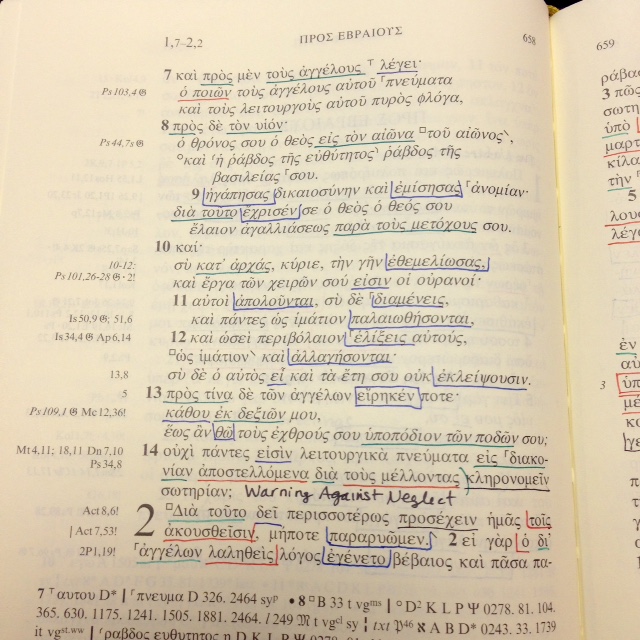
Blog

What if you could have a Greek NT that was marked to help you visually identify verbal aspect? This is a copy of my copy of NA28 and you will see that it is marked with various shapes and colors. Keep in mind that the system I present here is subjective. I use both color and shape codes to mark just the verbals. Prepositional phrases are underlined in green.

I use blue, black and red ink markers to designate the various verbal parts of speech: 
1. Indicatives, subjunctives, and imperatives are marked with blue.
2. Infinitives are marked with black.
3. Participles are marked with red.

And I use specific shapes to highlight the verbal aspect of the tense forms (these apply to all above verbal parts of speech):
1. Presents are simply underlined, noting their continuous aspect (think of a straight line going on continuously).
2. Imperfects are underlined and have a single vertical line at the end of the word, visualizing the continuous action in the past aspect of the imperfect.
3. Futures are just the converse of the imperfect; the future has an underline but a single vertical line at the beginning of the word, visualizing the open-ended view of the speaker/writer as they look to the future.
4. Aorists are underlined and then given small horizontal lines on each side of the word (this forms a large ‘U’-shape around the word, highlighting the undefined aspect).
5. Perfects are boxed, lines all the way around the word, emphasizing its heightened character, completed action and complexity in the view of the speaker/writer.

So, a present verb has a blue underline. An aorist participle has red lines underneath and on both sides. A perfect infinitive has a black box around it. By consistently incorporating a system like this, you will be able to visually identify how speakers/authors employ the various verbal parts of speech and tense forms. Such an aid for quick reading and exegesis!

Blog

“The disciples were first called Christians in Antioch” (Acts 11:19-26, CSB) is one of the well recognized phrases in Acts. When the church (leaders) in Jerusalem heard that the Gentiles in Antioch had received the gospel of the Lord Jesus and believed they sent Barnabas to confirm the account. Barnabas is ‘commissioned,’ designated with influence as a representative of the leaders in Jerusalem. What does Barnabas find? The grace of God in the lives of the people of Antioch. The flow of Acts 11:19-26 reads, concerning Barnabas, like the description of a child at Christmas. It is almost as if Barnabas cannot help himself, rushing off to Tarsus, about 100 miles by land, to get Saul and let him in on the pleasure of fellowship. This phrase about the disciples first being called Christians in Antioch frames the end of this account, describing the character of the church in Antioch as Barnabas uses his position of power to bring the pleasure of fellowship to the church with Saul.  

Each year for the last several I have been reading Acts in October. New Testament Christianity, as defined here, functions as individual believers and churches cooperate after the model established by Barnabas, the church in Antioch, and Saul. I have experienced a taste of this at the annual meeting of the KNCSB (Kansas-Nebraska Convention of Southern Baptists).

Though I have attended this particular annual meeting, and several like it, this is the first year I fulfilled any time of leadership role. I chair a small committee which sets the date and location for future meetings, and chooses the man who will deliver the annual Convention Sermon. When I was asked to be on this committee I was not jubilant to put another iron in the fire. However, knowing that Christianity functions through cooperation, I acquiesced. I am glad I did. I have had the chance to nominate and see to appointment two men who will offer a clinic in expository preaching and sound doctrine. Unfortunately these two hallmarks of ministry are at times absent in denominational life, so to have these slots secured for the next couple of years will have an influence upon the convention and younger pastors especially. And that is the ‘felt benefit’ of cooperation in New Testament Christianity. 

This is actually the second such instance for me in the last month. I have recently completed a two year term on the executive board of the Kansas City Kansas Baptist Association (KCKBA). Much of our work is prayer, support, and watching the budget. At my final meeting on the board we looked at the 2013 proposed budget and noticed that the KCKBA staff were not set to get any raises, though church offering is up from the previous year. Staff had taken some cuts and/or been flatlined in the last several years. During a lull in the board’s discussion I felt led to propose a motion that staff get raises. It just did not set right with me that if church giving is up their salaries should not proportionally and moderately reflect income. I had an opportunity to influence the situation, to exert the power conferred upon me as a board member. The board quickly agreed and next year, as a result of my influence, several salaries will be a few dollars more each day. The pleasure, the ‘felt benefit’ of influence, in this case, will be shared by some friends. Christianity is a Religion of Power and Pleasure.

Blog

In “Hebrews and the Mission of the Earliest Church” (pp. 327-45 in New Testament Theology in Light of the Church’s Mission: Essays in Honor of I. Howard Marshall. Cascade: Eugene, 2011), Jon C. Laansma argues that world mission is the “‘elephant in the room’ of Hebrews’s discourse” (330). He proposes that part of the wane in the audience of the Epistle is their lack of concern for world mission (330). I summarize Laansma’s storying of Hebrews to run something like this: (a) the community engaged in bold public and verbal witness, (b) because of this witness the community has suffered in a variety of ways, with the result that (c) some have responded to this suffering by disengaging from bold, verbal, public witness. “Without the author’s commenting in any direct way on that mission it is the raison d’être of the discourse” (332, italics original).

Laansma believes that the story of Hebrews is set within the broadest scope: cosmology, the macro spatial domain of both heaven and earth (336). Humanity’s plight is bound up with the renewal of the cosmos and the extensive frame of God’s mission. The community is called to faithfulness in this context: “Faithfulness, in other words, is not merely an abstract virtue, but is itself meaningful only within an assumed story that revolves around God’s reclamation and cleansing of his creation, his works. Faithfulness, therefore, is not about securing one’s own (actually, for Hebrews, the community’s) salvation by hanging on till the end, but about doing that precisely through adopting the same missiological aims that are at the heart of the gospel” (337-38, italics original). Παρρησία (boldness) thus functions horizontally and vertically (339).

In Laansma’s view, the spatial ἐξέρχομαι (to go out), referring to the community going out to identify with Jesus’ suffering outside the camp (Heb. 13:13), and προσέρχομαι (to go to, draw near) surfacing throughout the Epistle as the Author urges the community to approach God (Heb. 4:16; 7:25; 10:22; 11:6; 12:18, 22) are a single act of worship (341, italics original). “To put it bluntly, the sacred space of the divine throne—that which we are to ‘approach’ for mercy and grace—is not a ‘safe enclave’ in the midst of a violent and evil world but precisely the place of slaughter and sacrifice, of suffering redemptively with Christ. Even in the summons to ‘approach the divine throne’ with concern is not merely with personal comfort (on the verticle) but at the same time with a life of faithful obedience (on the horizontal)” (341).

“In short, the cultic imagery of Hebrews’ argument finally serves a comsmically universal vision of salvation that has swept up the people of God and, in its exhortations, carries them forward as active participants in that great drama” (341).

Laansma’s observations cohere Hebrews’ community exhortations with the ‘Great Commission’ exhortations so prominent throughout the New Testament (but on the surface absent in Hebrews). If he is right then the audience in view engages in community maintence as a means to an end outside of itself. Concern for one another stimulates and re-enforces the public witness of each one.

Blog

When Paul addresses the Corinthians he consistently urges them to think of what God has done in Christ, affirming their spirituality, but also challenges them to look at what is yet to come. In this way he both builds up and humbles. Paul’s treatment of spiritual gifts and love in 1 Corinthians 12-14 exemplifies his logic.

With most commentators, the Corinthians seem enamored with expressive, up-front kinds of spiritual gifts. These abilities are understood, in the church, to be gifts which help the body of believers to know God; they reveal Him in the sense of helping people to understand the message of Christ and life in Christ by the Spirit. Spiritual gifts help the body to see God. In the culture, however, these abilities were thought achievements and means to the end of self-promotion (cf. 1 Corinthians 2); these abilities help the talented to express themselves and gain favor. 

Paul corrects Corinthian thinking by arguing that even the best expression of spiritual gifts only dimly reveal God (1 Cor. 13:12). In light of the fact that even the best and most foundational gifts (prophecy and those related to speaking the gospel, cf. 1 Cor. 12:31; 14:1) will be useless when Christ returns and all of His fullness is revealed, the Corinthians should be concerned to demonstrate that which endures forever, i.e., love. The best sermon by the best preacher, the most uplifting music by the most talented musician, the smoothest organization by the most structured administrator may each and together make a significant impact for the kingdom and display the reality of Jesus’ death and resurrection, but these only dimly represent the God who will one day reveal Himself as the God of love (cf. 1 Cor. 15:23-28). The only hope these gifted individuals have of displaying that greater reality is to employ their gifts in love.

Blog

   Expect to be humbled. Students are accepted into the PhD program not because of what we have done but because of our potential. We probably know less than we think we know. Your weak spots will be revealed, so admit up front.

So get ready to learn. You will be forced to read like you have never read before. Read How to Read a Book (Adler and VanDoren, 1972), The Craft of Research (Booth, Colomb, and Williams, 2008), and Ancient Texts for New Testament Studies (Evans, 2005). Go to a professional meeting in your first year (ETS/SBL). There you can get a perspective of the issues relevant to your interests. You cannot begin until you know where things stand.

Expect challenges in communication with supervisors and faculty. Though PhD students are important to the seminary, the faculty is busy and we must wait our turn. Expect the process to be as challenging as the academic work.

So work at communication. Every time you meet with faculty, follow-up with detailed e-mail and cc the doctoral studies secretary. Say what you have done, what you hope to do and the deadlines involved. Don’t let anything catch anyone by surprise.

Expect your faith to be challenged. You will be pressured, you may feel put-down. You may have personal challenges along the way ($, family, ministry). You may have to take time off. God may call you to step away from the PhD. There is a whole spectrum of challenge awaiting PhD students.

Rest in the faithfulness of God. Whatever point you find yourself on this spectrum know that God is faithful. Never lose sight of the fact that your Christianity is not based upon your papers, comps or dissertation, but Jesus’ death and resurrection. In some ways PhD studies are icing on the cake of Christianity. Enjoy Jesus and the fellowship of the Spirit.

Expect physical challenges. Lack of sleep, lots of sitting, too much caffeine can have long and short term affects on your body. Eye strain and neck pain will slip into your book bag and follow you home from the library.

So take care of your body. Read standing up. Get an exercise program. Be moderate with sweets and caffeine. Get an exercise program. Put ice on your neck at night. There is nothing godly about getting a PhD and 30 pounds in the process.

Expect tech challenges. In a day of instant back up and storage there is no excuse for losing research, but computers will crash and downloads will fail.

Today begin to equip yourself for tech success. Purchase a reliable laptop, word processor, and research software. I suggest a Mac, Word for Mac, and EndNote.

Blog